Options lists are where a $109,500 trailer quietly becomes a $175,000 one. On most RVs that math is depressing — you’re paying for trim badges and upholstery. On the Pebble Flow it’s more interesting, because several of the options don’t change how the trailer looks. They change what you can do with it, and where you can park it.
Below is every option Pebble offers, what it actually does once you’re at a campsite, and our honest read on whether it earns its money. Prices come from Pebble’s own configurator and were confirmed against Overland Expo’s pricing breakdown.
The lineup at a glance
| Option | Price | What it changes |
|---|---|---|
| Rooftop solar (1.1 kW) | $4,000 | Recharges the pack while parked — the difference between a battery that drains and one that refills |
| Exterior smart privacy glass | $4,000 | The 270° glass turns opaque on demand |
| All-terrain levelers | $2,250 | Auto-leveling on soft, uneven or sloped ground |
| Motorized awning | $1,750 | Shade deploys with the rest of InstaCamp, no cranking |
| Magic Pack (dual motors) | +$26,000 | Self-hitching, remote parking, tow assist, Auto Dump |
| Founders Edition | $175,000 | Everything above plus exclusive extras and lifetime roadside |
Base Flow Standard is $109,500; the Magic Pack configuration starts at $135,500. Confirm current pricing on Pebble’s order page — options and prices change.
Rooftop solar — $4,000
Buy it. If you only tick one box, tick this one.
The Flow carries a 45 kWh battery, which Pebble says is good for roughly seven days off-grid. That number quietly assumes you’re putting energy back in. Without solar, seven days is a countdown: you arrive full, you leave empty, and everything in between is rationing. With the 1.1 kW array on the roof, the trailer is topping itself up every daylight hour you’re out hiking.
The practical difference isn’t really about running out. It’s about not thinking about running out. Air conditioning is the single biggest draw on any RV, and it’s the thing people ration hardest when they’re watching a battery percentage. Solar is what lets you run the heat pump on a hot afternoon without doing arithmetic first.
It also compounds with the Flow’s party trick: 12 kW of power export through an exterior NEMA 14-50 outlet. A trailer that refills itself from the sun and can push power back out is genuinely a different appliance than one that just holds a charge.
Solar is the option that changes the category the trailer belongs to. Without it you have a very large battery. With it you have an energy system.
All-terrain levelers — $2,250
Buy it if you camp anywhere but paved sites.
Every Flow can level itself. The all-terrain upgrade is about where it can do that — soft dirt, gravel, forest duff, and sites with real slope, the kind of ground where standard pads sink or slide.
This is an easy one to talk yourself out of on a spec sheet and an easy one to regret at 9pm in a dispersed site in the Sierras. An unlevel trailer isn’t just uncomfortable to sleep in; it affects how the fridge runs and how the tanks drain. The people who should skip it are those who genuinely only stay at developed, full-hookup parks. If your idea of camping includes national forest roads, this is not really optional.
Motorized awning — $1,750
Buy it — but for a subtler reason than you’d think.
A manual awning is a two-minute job. Nobody needs a motor for two minutes of work. The reason this option is worth more than it looks is that it folds shade into InstaCamp — the one-tap sequence that levels the trailer, drops the stairs, sets the temperature and turns on the lights.
The value of a one-tap camp setup collapses the moment one step still requires you to walk outside and crank something. Automating the awning is what keeps the whole sequence honest. It’s the cheapest option on the list and it protects the feature the trailer is built around.
The counter-argument is real, though: powered awnings are a known failure point across the RV industry, and a motor is one more thing that can break far from a service center. Pebble covers appliances and accessories for one year or 10,000 miles, shorter than the trailer’s own three-year coverage.
Exterior smart privacy glass — $4,000
The hardest one to justify — and the one we’d still probably buy.
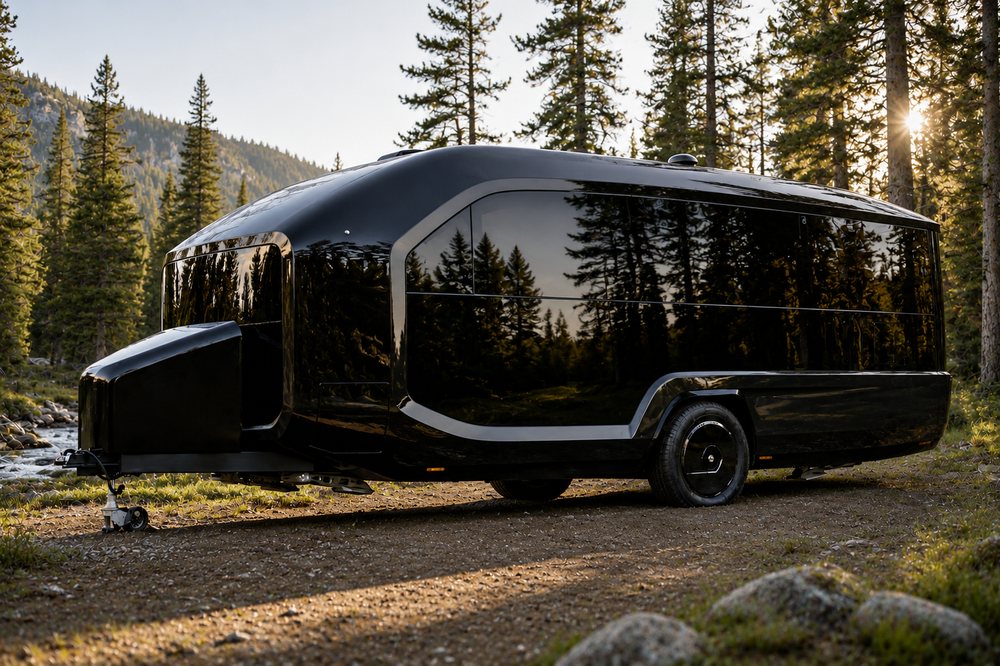
The Flow’s signature is 270 degrees of wraparound glass, described by Fast Company when the trailer was revealed as its most striking design feature. That glass is the entire point of the interior. It’s also, at night with the lights on, a fishbowl.
Smart glass solves this by turning opaque on demand — no curtains, no blinds, nothing hanging in front of the view you paid for. Curtains would work. They’d cost a few hundred dollars. They’d also visually undo the reason the trailer looks like that.
Judged as a privacy solution, $4,000 is absurd. Judged as the thing that lets a glass-walled trailer stay glass-walled, it’s more defensible. This is the most personal call on the list, and the one most worth seeing in person before deciding.
The Magic Pack — +$26,000
Not an accessory. The actual product decision.
Everything above is a few thousand dollars. The Magic Pack is the jump from $109,500 to $135,500, and it isn’t a trim level — it’s the dual-motor drivetrain. Without it the Flow is a beautifully-built electric trailer. With it, the trailer moves under its own power, and that unlocks the features people actually talk about:
- Magic Hitch — the trailer sights your tow vehicle and hitches itself
- Remote Control — reverse and park from your phone, including a 360° spin in place
- Active Tow Assist — the motors push while you drive, easing load on the tow vehicle
- Auto Dump — near touch-less black and grey tank emptying
Whether that’s worth $26,000 depends almost entirely on one question: what does towing anxiety cost you? For a household where one person is comfortable backing a trailer and the other isn’t, this is the option that decides whether the trailer gets used by both of them, or just one. For someone who has backed trailers their whole life, it’s a very expensive convenience.
Worth being clear on the limits: tow assist doesn’t change the GVWR or tongue weight. Your vehicle still needs to be rated for roughly 6,800 lbs regardless.
Founders Edition — $175,000
The fully-loaded configuration bundles every option above and adds extras you can’t buy separately: premium bedding and mattress, a portable projector speaker, a tow hitch with integrated tongue-weight measurement, an exclusive Fern paint colour, white-glove service, Founders Club access, and lifetime roadside assistance.
Add up the four standalone options and you get $12,000. The Magic Pack adds $26,000. That’s $147,500 — so the Founders premium is roughly $27,500 for bedding, a projector, a smarter hitch, paint, and service perks.
The one item there with real substance is the integrated tongue-weight measurement. Improper tongue weight is a genuine cause of trailer sway and accidents, and most owners guess at it or drive to a scale. Building it into the hitch is a safety feature, not a luxury. Whether it’s a $27,500 safety feature is another question — and lifetime roadside assistance on a brand-new vehicle from a young company is worth more than it sounds.
Where we’d spend the money
If we were configuring one tomorrow, in order:
- Rooftop solar ($4,000) — non-negotiable. It's what makes the off-grid claim real.
- All-terrain levelers ($2,250) — if you ever leave pavement.
- Motorized awning ($1,750) — cheap, and it protects InstaCamp.
- Magic Pack (+$26,000) — only you can answer this one, and it's the biggest number on the page.
- Smart glass ($4,000) — wonderful, genuinely optional.
That’s roughly $8,000 of options on a base trailer, or $34,000 with the drivetrain. The pattern worth noticing: the options that earn their money are the ones that remove a chore or a worry, not the ones that add a feature. Solar removes rationing. Levelers remove site anxiety. The awning removes the one manual step in an automated sequence.
Why we care about this trailer
This site exists because of a Reddit ad. A friend had invited us up to the Sierras for a weekend, I was doing some idle camping research, and a Pebble Flow ad turned up in my feed. One click through to their site and I was hooked — my wife and I spent weeks talking seriously about buying one.
Then we bought a house instead, about a year ago. The Flow went back on the someday list. We’ll revisit it when things settle down — and in the meantime, this is where we keep track of everything we learn about it.
Sources: option pricing from Pebble’s configurator and Overland Expo; design and interior detail from Fast Company; specifications and warranty terms from Pebble’s spec sheet and FAQ. Prices and options are subject to change. This is an independent fan site; nothing here is a purchase recommendation.
Join the conversation
Comment embed goes here.